
Why your cyber insurance application or renewal might be denied or come with much higher premiums even if you think you are protected.
At KartHost we talk with small business owners in the Tomball and Houston area who are surprised when their cyber insurance carrier asks detailed questions about MFA, email authentication, and backups. Many policies now require specific technical controls before they will cover ransomware, business email compromise, or domain hijacking claims. Meeting these expectations is no longer optional if you want affordable coverage that actually pays out.
Here is what most cyber insurers look for in 2026, why your email and domain setup matter so much, and a practical checklist you can use right now.
Why Cyber Insurance Carriers Care About Your Email and Domain
Email remains the number one entry point for attacks. Cyber policies have tightened because carriers have paid out billions in claims from phishing, spoofed domains, and ransomware that starts with a compromised mailbox. Insurers now underwrite more like a security audit. They want proof you have basic protections in place so they are not just writing blank checks.
Your domain and DNS records play a big role too. Proper SPF, DKIM, and DMARC show you control who can send email using your brand. Weak or missing records signal higher risk. The same goes for admin access to your domain registrar and email platform. If those accounts get taken over, attackers can redirect your entire online presence.
What Insurers Typically Expect in 2026
Most carriers ask for the following core controls (especially for small businesses with email and online operations):
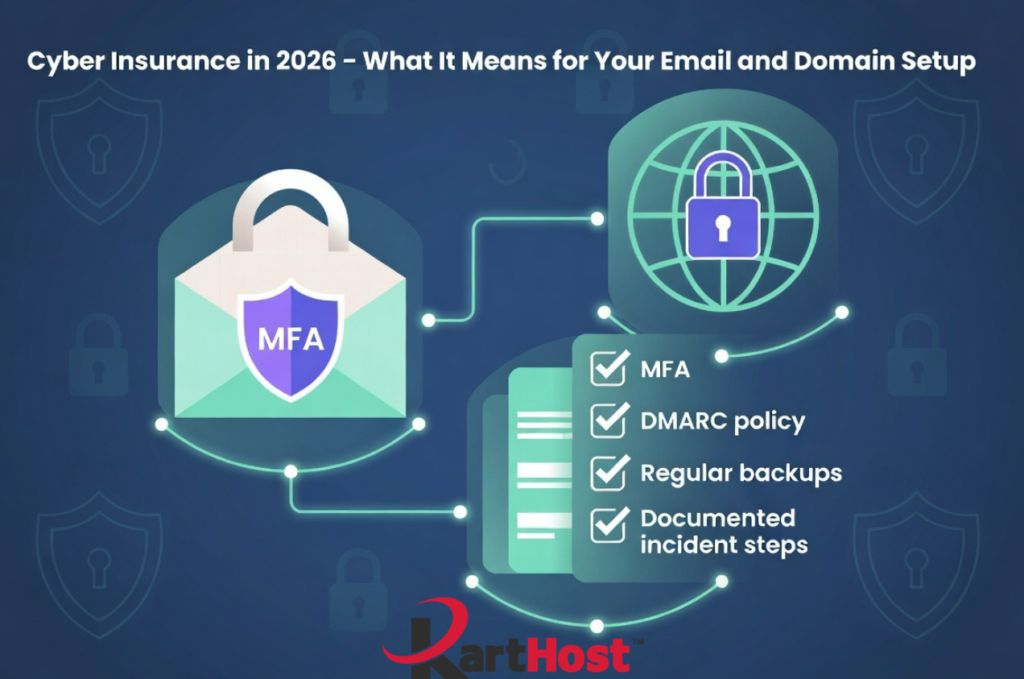
- Multi-factor authentication (MFA) enforced on all administrative accounts, email access, and remote tools.
- Strong email authentication (SPF, DKIM, DMARC with a policy at least at quarantine or reject).
- Regular, tested backups (ideally immutable or offline copies).
- A documented incident response plan with clear first steps after a suspected breach.
- Additional items like endpoint protection, security awareness training, and timely patching often appear on applications.
Failing these can lead to higher premiums, limited ransomware coverage, or outright denial.
Quick Checklist – Cyber Insurance Readiness for Email and Domain
Use this as your starting point. Review it quarterly or before any renewal.
- MFA on Admin Accounts
Enable and enforce MFA everywhere it counts: your domain registrar account, DNS management, Microsoft 365 / KloudEmail admin portals, and any other cloud services. Avoid SMS if possible. Use authenticator apps or hardware keys for stronger protection. Check that it applies to all users with admin rights, not just some. - DMARC Policy (and Supporting SPF / DKIM)
Set up SPF and DKIM first, then add a DMARC record. Start with p=quarantine and move to p=reject once you have monitored for a few weeks. This tells receiving servers what to do with emails that fail authentication and dramatically reduces spoofing attacks that could trigger a claim. - Regular Backups with Testing
Maintain recent backups of your website, email data (if available through your provider), and critical files. Prefer immutable backups that cannot be altered by ransomware. Document and actually test a restore at least once per quarter. Many carriers specifically ask for proof of successful test restores. - Documented Incident Response Steps
Create a simple one-page plan that answers: Who do we call first if we suspect a breach? How do we preserve evidence? Who notifies customers or authorities? Where are our backups and how do we restore? Keep it updated and accessible to key team members. Even a basic plan satisfies most underwriters. - Bonus Items That Strengthen Applications
Enable advanced threat protection on your email service, run occasional phishing simulations for staff, and keep domain contact information private and accurate.
What KartHost Recommends and How We Help
Meeting these requirements does not have to be overwhelming. Many of our KloudEmail and Microsoft 365 customers already have the foundation in place. We help close the gaps so you can confidently apply for or renew cyber insurance.
Our local Texas team can:
- Review your current MFA setup across email and domain accounts
- Implement or strengthen SPF, DKIM, and DMARC records
- Audit and document your backup processes
- Help create or refine a basic incident response plan
- Provide evidence and screenshots needed for insurance questionnaires
Interested in starting with us? Go to https://karthost.com/ to explore our domain, email, and hosting products and get started!
Taking these steps protects your business daily and keeps your insurance partner on your side when it matters most. We are here to help you check every box with practical, manageable solutions.